Showing posts with label hand out plant. Show all posts

Primary and Secondary Growth

on Tuesday, August 9, 2011
Growth is the process by which a plant increases in the number and size of leaves, roots, and stems. The growth in plants depends on the hormones which are produced in minute amounts and the physiological effect is shown at other site.
The growth in plants is studied at two different levels such as primary and secondary. The primary growth refers to increase in length of plant, number of leaves, and production of branches. Secondary growth refers to increase in girth and growth associated with girth.


Primary Growth
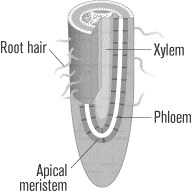
It refers to the growth taking place in apical surface where higher amount of cell division takes place in apical meristem. The high pace of cell division results in cell elongation and takes place in undifferentiated regions referred as meristems.


The primary growth in roots is concentrated at root tip and is covered by the presence of root cap. The root cap produces polysaccharide and help in rapid rate of growth. The growth at the apical meristem in roots takes place at rapid phase and results in replacement of cells at root cap. 
 
Secondary Growth

Secondary growth in plants takes place in vascular cambium and at a later stage it produces secondary xylem cells in the inside of the meristem and formation of secondary phloem cells on the outside of the meristem.


It is found that the secondary growth disturbs the epidermis in terms of rupture it results in formation of cork cambium which is in general dark and gives rise to thickened cork cells. The thickened cork cells are known for their role to protect. 

 
The Differences 

Primary Growth

Secondary Growth

Taking place at the tip of the plant (tip of shoot and tip of root)

Taking place in the stem

Occur in every plants

Occur only in woody plants

Increase in length of plant, number of leaves, and production of branches

Increase in girth or diameter

Occur by the activity of apical meristem

Occur by the activity of Cambium
 

Download Hand Out Here! 

Plant Hormones


The growth and development of a plant are influenced by genetic factors, external environmental factors, and chemical hormones inside the plant. Plants respond to many environmental factors such as light, gravity, water, inorganic nutrients, and temperature.

Plant hormones are chemical messengers that affect a plant's ability to respond to its environment. Hormones are organic compounds that are effective at very low concentration; they are usually synthesized in one part of the plant and are transported to another location.  They interact with specific target tissues to cause physiological responses, such as growth or fruit ripening. Each response is often the result of two or more hormones acting together.

Because hormones stimulate or inhibit plant growth, many botanists also refer to them as plant growth regulators. Many hormones can be synthesized in the laboratory, increasing the quantity of hormones available for commercial applications. Botanists recognize five major groups of hormones: auxins, gibberellins, ethylene, cytokinins, and abscisic acid.


Auxins

Auxins are hormones involved in plant-cell elongation, apical dominance, and rooting. A well known natural auxin is indoleacetic acid, or IAA which is produced in the apical meristem of the shoot.
Before a cell can elongate, the cell wall must become less rigid so that it can expand. IAA triggers an increase in the plasticity, or stretch ability, of cell walls, allowing elongation to occur.
Auxin moves to the darker side of the plant, causing the cells there to grow larger than corresponding cells on the lighter side of the plant. This produces a curving of the plant stem tip toward the light, a plant movement known as phototropism.


Gibberellins

In the 1920's scientists in Japan discovered that a substance produced by the fungus Gibberella caused fungus-infected plants to grow abnormally tall. The substance, named gibberellin, was later found to be produced in small quantities by plants themselves.

Gibberellins has many effects on a plant, but primarily stimulates elongation growth. Spraying a plant with gibberellins will usually cause the plant to grow to a larger than expected height, i.e. greater than normal.
Gibberellins are also used to treat seeds of some food crops because they will break seed dormancy and promote uniform germination.

Ethylene

The hormone ethylene is responsible for the ripening of fruits. Unlike the other four classes of plant hormones, ethylene is a gas at room temperature. Ethylene gas diffuses easily through the air from one plant to another.
Ethylene is usually applied in a solution of ethephon, a synthetic chemical that breaks down and releases ethylene gas. It is used to ripen bananas, honeydew melons and tomatoes.  

Cytokinins

Cytokinins promote cell division in plants. It is produced in the developing shoots, roots, fruits and seeds of a plant, cytokinins are very important in the culturing of plant tissues in the laboratory.  A high ratio of auxins to cytokinins in a tissue-culture medium stimulates root formation. A low ratio promotes shoot formation. Cytokinins are also used to promote lateral bud growth in flowering plants.

Abscisic Acid

Abscisic acid, or ABA, generally inhibits other hormones, such as the auxin IAA. It was originally thought to promote abscission, hence its name. ABA helps to bring about dormancy in a plant's buds and maintains dormancy in its seeds. ABA causes the closure of a plant's stomata in response to drought. Water stressed leaves produce large amounts of ABA, which triggers potassium ions to be transported out of the guard cells. This causes stomata to close, and water is held in the leaf. It is too costly to synthesize ABA for commercial agriculture use.  

Source: http://www.emc.maricopa.edu/faculty/farabee/biobk/biobookplanthorm.html 
http://www.biology-online.org/11/10_growth_and_plant_hormones.htm 
Germination


Germination is the process in which a plant or fungus emerges from a seed or spore, respectively, and begins growth. The most common example of germination is the sprouting of a seedling from a seed of an angiosperm or gymnosperm. 
Seed germination depends on both internal and external conditions. The most important external factors include temperature, water, oxygen and sometimes light or darkness.


Dicot Germination
The part of the plant that first emerges from the seed is the embryonic root, termed the radicle or primary root. It allows the seedling to become anchored in the ground and start absorbing water.
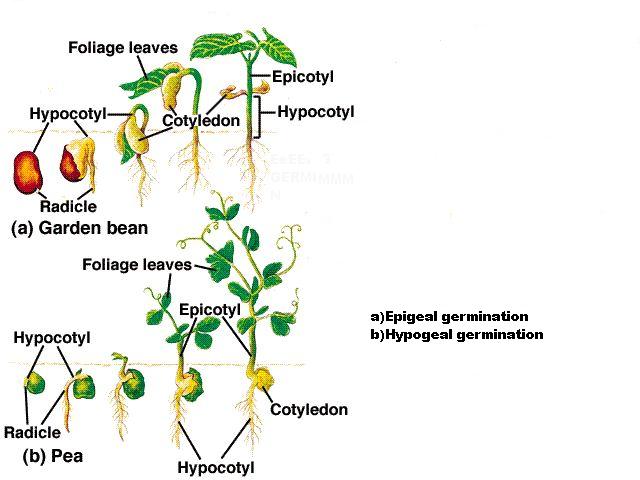
After the root absorbs water, an embryonic shoot emerges from the seed. This shoot comprises three main parts: the cotyledons (seed leaves), the section of shoot below the cotyledons (hypocotyl), and the section of shoot above the cotyledons (epicotyl).
The way the shoot emerges differs among plant groups.
  •  Epigeous
       In epigeous (or epigeal) germination, the hypocotyl elongates and forms a hook, pulling rather than pushing the cotyledons and apical meristem through the soil. Once it reaches the surface, it straightens and pulls the cotyledons and shoot tip of the growing seedlings into the air. Beans, tamarind, and papaya are examples of plants that germinate this way.

  • Hypogeous
Another way of germination is hypogeous (or hypogeal), where the epicotyl elongates and forms the hook. In this type of germination, the cotyledons stay underground where they eventually decompose. Peas, for example, germinate this way.


 Monocot germination

In monocot seeds, the embryo's radicle and cotyledon are covered by a coleorhiza and coleoptile, respectively. The coleorhiza is the first part to grow out of the seed, followed by the radicle. The coleoptile is then pushed up through the ground until it reaches the surface. There, it stops elongating and the first leaves emerge